SOC 2 defines criteria for managing customer data based on five trust service principles.
ISO 27001 (ISMS)
ISO 27001 requires establishing, implementing, and maintaining a comprehensive information security management system.
HIPAA
HIPAA establishes standards for protecting sensitive patient health information with requirements for data privacy, security provisions, and breach notifications.
GDPR
GDPR enforces strict data protection regulations for organizations operating in the EU, requiring consent, transparency, and giving individuals control over their personal data.
Australian Privacy Principle (APP)
APPs outline how Australian organizations must handle, use, and manage personal information, covering collection, use, disclosure, and data security requirements.
Any Custom Framework
Create and implement customized compliance frameworks tailored to your specific industry requirements, internal policies, or regional regulations.
Integrations
400+ Integrations
Automatically collect evidence and monitor compliance with current and upcoming integrations.
The Compliance Automation Lie: Your Tool Tracks the Work. You Still Do It
Chaitanya
February 18, 2026
TL;DR:
Most compliance tools automate monitoring, not execution
Your team still writes policies, collects evidence, fills questionnaires — the tool just organised the queue
"AI-powered" usually means AI suggests, you do the work
The fix isn't a better checklist — it's agents that execute the work for you
SOC 2 or ISO 27001 in 4-6 weeks when agents do the work, not track it
.
What "compliance automation" actually means (and what it doesn't)
Every compliance tool on the market calls itself automated. Vanta. Drata. Scrut. Sprinto. All of them.
What they actually automate: monitoring. Dashboards. Alerts. Task lists. Reminders to your team about what needs doing next.
What they don't automate: the work.
Your team still writes policies — or fills in templates someone else wrote. Your team still collects evidence — or uploads screenshots when the tool asks. Your team still answers security questionnaires — manually, one question at a time. Your engineers still get pulled off product every time an audit cycle hits.
The tool organised the queue. Your team is still the engine.
This isn't a criticism of those tools — they're genuinely better than spreadsheets. But calling task management "compliance automation" is the lie. And until you see it clearly, you'll keep wondering why certification still takes months even though you're paying for "automation."
Here's what a typical compliance journey looks like with a traditional tool.
Week 1: Team logs in, connects integrations, sees 200 tasks. Starts working through them.
Week 2: Engineer spends three days uploading evidence screenshots before a sprint kicks in. Compliance gets deprioritised.
Week 4: Security questionnaire arrives from a prospect. Someone spends two weeks answering it manually.
Week 8: Auditor asks for an Incident Response Policy. CTO writes it over a weekend.
Week 12: Audit prep begins. Three engineers pulled off product to collect evidence, organise it, and respond to auditor queries.
The tool was running the whole time. Sending reminders. Updating the dashboard. Tracking progress.
But every deliverable — every policy, every evidence upload, every questionnaire answer — was produced by a human.
That's not automation. That's project management with a compliance theme.
What actually changes with agentic compliance
Agentic compliance is a different category. Not a better dashboard. Not smarter reminders. Agents that do the work.
Here's the practical difference:
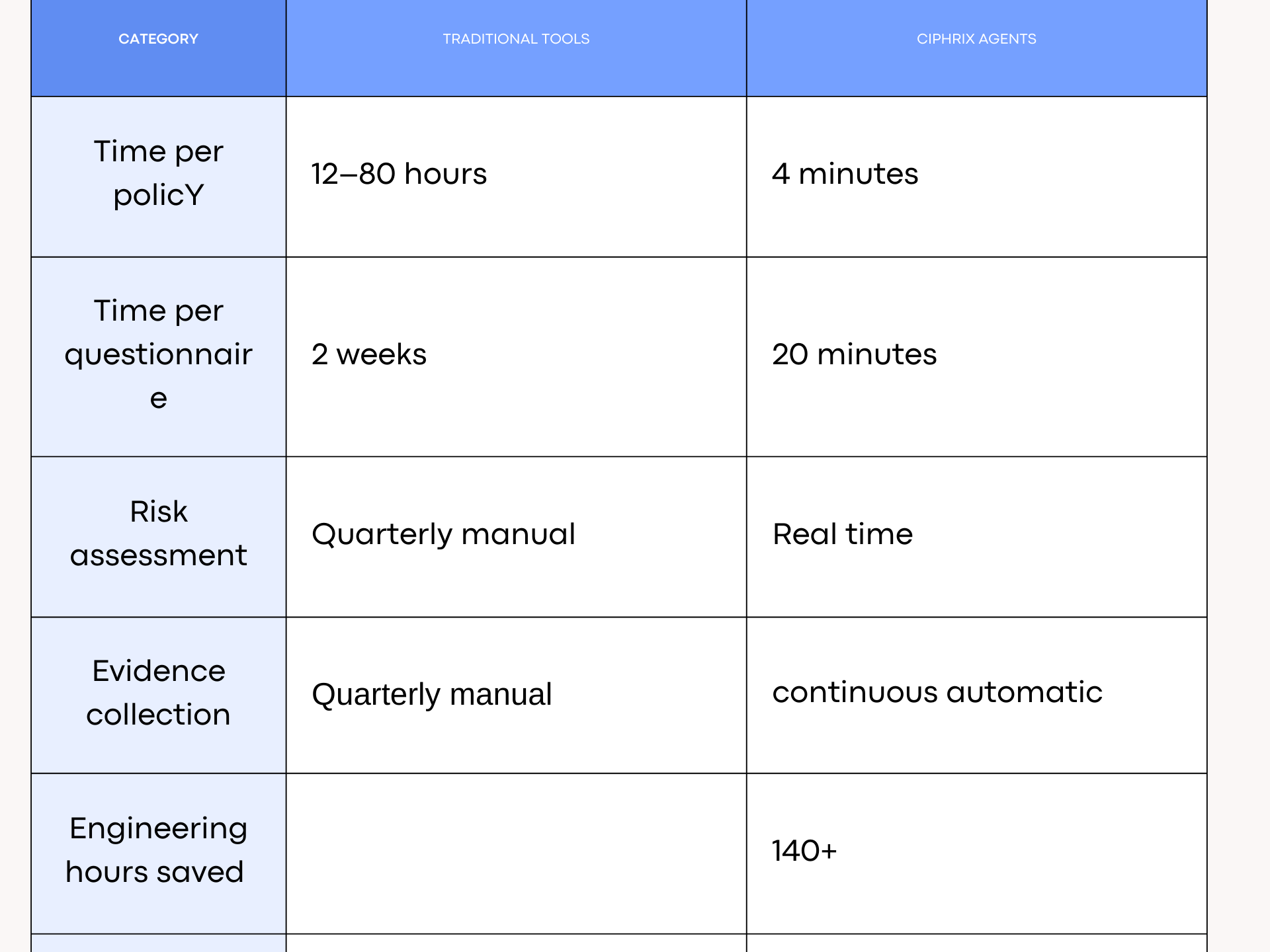
Policy Agent — doesn't give you templates to fill. Reads your stack, analyses your framework requirements, and writes a complete customised policy document. An 8-page Incident Response Policy mapped to ISO 27001 A.16 — in 4 minutes. Traditional time: 12-80 hours per policy.
Evidence Agent — doesn't remind you to upload screenshots. Connects to 500+ tools including AWS, GitHub, and Okta. Pulls live configurations continuously. Maps evidence to controls across every framework simultaneously. Auditors see live data, not stale exports.
Questionnaire Agent — doesn't open a portal for your team. Reads the security questionnaire, pulls answers from your live compliance environment, and auto-fills 90% of questions with evidence-backed responses. An 80-question vendor assessment: 18 minutes total. Traditional time: 2 weeks per vendor.
Risk Agent - doesn't flag gaps and wait. When your DevOps team deploys a new AWS S3 bucket, the agent discovers it, scores the risk, and recommends specific remediations in 2 minutes.
The model is simple: agents execute, your team reviews and approves. That's it.
The ROI case and CTA
What this means for your timeline and budget
When agents do the work instead of tracking it, the numbers change completely.
Timeline vs Budget
One customer processing 15 security questionnaires a month saved 120 hours monthly. That's three weeks of engineering time — every month — given back to product.
The question to ask every compliance vendor
Not "do you have AI features?" Every tool does now.
Ask: "After your AI acts, what work lands on my team?"
If the answer is policies to fill, evidence to upload, questionnaires to answer — you're buying a tracking tool with AI sprinkled on top.
If the answer is "your team reviews and approves" — that's agentic compliance.
What is the difference between compliance automation and agentic compliance?Compliance automation tracks and monitors your compliance tasks. Agentic compliance executes them. With traditional tools your team still writes policies, collects evidence, and fills questionnaires. With agentic compliance, AI agents do that work and your team reviews and approves the output.
Does agentic compliance work for both SOC 2 and ISO 27001?Yes. Ciphrix agents work across SOC 2, ISO 27001, HIPAA, GDPR, and custom frameworks simultaneously. Evidence collected once is mapped to controls across all frameworks automatically.
How long does SOC 2 or ISO 27001 take with Ciphrix?4-6 weeks for most companies. Traditional tools or consultants typically take 3-6 months because your team is doing the execution work. When agents do it, the timeline compresses significantly.
Do we still need a human auditor?Yes. Ciphrix prepares everything the auditor needs — policies, evidence, control mappings — but the final audit is conducted by an independent CPA firm (SOC 2) or accredited certification body (ISO 27001). Agents do the prep work. Auditors do the verification.
What tools does Ciphrix connect to?500+ integrations including AWS, Azure, GitHub, Okta, Google Workspace, Jira, and more. Evidence is pulled live from your actual environment, not uploaded manually.
What happens after certification?Evidence collection continues automatically. Risk monitoring runs in real-time. When your renewal audit comes around, most of the work is already done.
Wrap-Up
Compliance tools didn't lie to you about their intentions. They built genuinely useful monitoring and tracking software. But somewhere along the way "automation" became a marketing word that stopped meaning what it says.
The work still lands on your team. The engineers still get pulled. The CTO still writes policies on weekends.
Agentic compliance changes that. Not by tracking the work more efficiently — by doing it.
SOC 2 or ISO 27001 in 4-6 weeks. Your team reviews and approves. That's it.
Chaitanya is Head of Marketing at Ciphrix, an agentic compliance startup. He has led growth at several YC-backed companies and holds postgraduate degrees from Cambridge Judge Business School and Cardiff University. A keynote speaker at international conferences, he writes about compliance automation, agentic AI, and what it actually takes to scale B2B SaaS.


.svg) Back
Back.svg) AI Powered Automations
AI Powered Automations Policy Agent
.svg) Compliance Core
Compliance Core Compliance Engine
 Controls Management
 Automated Evidence
 Integrations (450+)
 Policy Management
 Audit Center
 Findings & Corrective Actions
 Third-Party Management
 Data Sub-processor Management
 Supply Chain Attack Surface Monitoring
 User Access Management
.svg) Risk Management
Risk Management Trainings
 Trust Center
.svg) SOC 2
SOC 2.svg) ISO 27001 (ISMS)
ISO 27001 (ISMS).svg) HIPAA
HIPAA.svg) GDPR
GDPR.svg) Australian Privacy Principle (APP)
Australian Privacy Principle (APP).svg) Any Custom Framework
Any Custom Framework.webp) 400+ Integrations
400+ Integrations.svg) Blog
Blog.svg) Help Center
Help Center.svg) Free Tools
Free Tools.svg) About Us
About Us Our Partners
.svg) Careers
Careers.svg) Contact Us
Contact Us.svg) Trust Center
Trust Center.svg)
.svg)
.svg)


.webp)
.svg)