SOC 2 defines criteria for managing customer data based on five trust service principles.
ISO 27001 (ISMS)
ISO 27001 requires establishing, implementing, and maintaining a comprehensive information security management system.
HIPAA
HIPAA establishes standards for protecting sensitive patient health information with requirements for data privacy, security provisions, and breach notifications.
GDPR
GDPR enforces strict data protection regulations for organizations operating in the EU, requiring consent, transparency, and giving individuals control over their personal data.
Australian Privacy Principle (APP)
APPs outline how Australian organizations must handle, use, and manage personal information, covering collection, use, disclosure, and data security requirements.
Any Custom Framework
Create and implement customized compliance frameworks tailored to your specific industry requirements, internal policies, or regional regulations.
Integrations
400+ Integrations
Automatically collect evidence and monitor compliance with current and upcoming integrations.
ISO 27001 vs SOC 2 (2026): Which Should You Do First?
chaitanya
TL;DR:
Your biggest enterprise prospect just sent the security questionnaire. Question 47: "Provide your current SOC 2 Type II report OR ISO 27001 certificate."
You have neither. The deal's on hold until you do.
Which one do you get first? Wrong choice = 6+ months wasted, $50K spent on the certification buyers don't actually need, and your competitor with the right cert closes the deal while you're still in audit.
Here's how to choose: ISO 27001 vs SOC 2. Both prove you take security seriously, but they work differently. SOC 2 is a CPA attestation against Trust Services Criteria the US enterprise standard. ISO 27001 is an international ISMS certification the global gold standard. In 2026, the right choice comes down to where your revenue lives and which certification your buyers actually check for.
ISO 27001 vs SOC 2 at a Glance
What is SOC 2?
SOC 2 is an independent attestation performed by a CPA firm against the Trust Services Criteria: Security (required), plus optional Availability, Confidentiality, Processing Integrity, and Privacy.
Type I looks at control design at a point in time. Type II evaluates operating effectiveness across a period (commonly 3–12 months). You walk away with a narrative report you can share under NDA. It's the US enterprise comfort blanket.
What is ISO 27001?
ISO/IEC 27001 certifies your ISMS—the system that governs risks, policies, and controls. You align controls via your Statement of Applicability, referencing Annex A (93 controls), then complete Stage 1 and Stage 2 audits with an accredited certification body.
You earn an internationally recognized certificate on a three-year cycle, with annual surveillance. Think of it as your global passport.
Key Differences That Matter to Buyers
Deliverable — Report vs Certificate
SOC 2: an AICPA-style attestation report (Type I/II). US buyers ask for it by name. ISO 27001: a formal certificate many global procurement teams are trained to look for.
Scope & Control Model — TSC vs Annex A (93)
SOC 2 lets you pick criteria beyond Security, which gives you scope flexibility. ISO 27001 expects a documented ISMS with real governance: risks, owners, SOPs, logs, and an SoA explaining what's in and why. Less wiggle room, more structure.
Audit Cadence — Type I/II vs Stage 1/2 + Surveillance
SOC 2: renew annually; Type II covers an operating period. ISO 27001: 3-year certification with annual surveillance, then recertification.
Regional Recognition — US vs Global
SOC 2: the de-facto US ask for SaaS and cloud vendors. ISO 27001: global signal, especially in EMEA/APAC and regulated sectors.
ISMS with Annex A (93 controls) + Statement of Applicability (SoA)
Audit cadence
Annual; Type II covers an operating period
3-year certification; annual surveillance; recertification at year 3
Buyer signal
Strong in US enterprise SaaS
Strong globally and in regulated sectors
Document you share
SOC 2 report (usually under NDA)
Certificate + audit scope statement
Flexibility
High (choose criteria; can narrow initial scope)
Programmatic, structured governance across ISMS
Buyer Signals & Procurement Realities in 2026
Buyer Signals & Procurement Realities in 2026
Security asks aren't random they're shortcuts buyers use to de-risk vendors fast. Here's exactly what you'll see in real deals.
What Buyers Actually Say
US Enterprise SaaS Deals:
"Provide your current SOC 2 Type II report (must be within last 12 months)"
"We require SOC 2 for all cloud vendors handling customer data"
Security questionnaire asks: "Have you completed a SOC 2 audit? If yes, provide report"
Global/EMEA/APAC Deals:
"Provide your ISO/IEC 27001 certificate and Statement of Applicability"
"ISO 27001 certification is required for vendor onboarding"
Partner program docs: "ISO 27001 certified vendors receive priority evaluation"
Regulated Industries (Finance/Healthcare/Gov):
"Both SOC 2 Type II AND ISO 27001 required"
"Provide SOC 2 with HITRUST or ISO 27001 with SOC 2"
These aren't negotiable. They're checkboxes in procurement systems—no cert = no progression.
Who's Actually Checking
The security reviewer is rarely a compliance specialist. They're:
IT Security Manager with 50 vendor reviews in queue
Procurement Analyst checking boxes on a risk scorecard
Legal Counsel validating you meet internal policy requirements
Their job: reduce risk, fast. They don't read your security whitepaper. They check:
Do you have SOC 2 or ISO? (Yes/No)
Is it current? (Yes/No)
Does the scope match what we're buying? (Yes/No)
If US-based: SOC 2 Type II (shared under NDA) closes 80% of questions immediately. If global/regulated: ISO 27001 certificate is the signal they recognize and trust.
The Timing Trap
Most startups wait until a big deal asks for certification to start the audit. By then:
US-first pipeline: Get SOC 2 Type I (3-6 months) as soon as you have 3-5 enterprise prospects. Show buyers: "Type I complete, Type II audit scheduled for Q3"
Global pipeline: Start ISO 27001 when international deals hit 30% of pipeline. Show buyers: "Stage 1 complete, Stage 2 audit July 2026"
Buyers accept "in-progress with date" if you're transparent. They reject "we're looking into it."
What Actually Shortens Review Cycles
Beyond the cert itself, buyers check:
Trust Center: Public page with policies, sub-processors, incident contacts
Clear scope statement: What's covered, what's not, which data flows
These aren't substitutes for SOC 2/ISO, but they prevent follow-up rounds. Buyer sees: "They have their act together" and moves to contract negotiation instead of remediation loops.
Bottom line: Give buyers the certification their procurement system expects. Everything else is just context.
Timelines & Costs in 2026
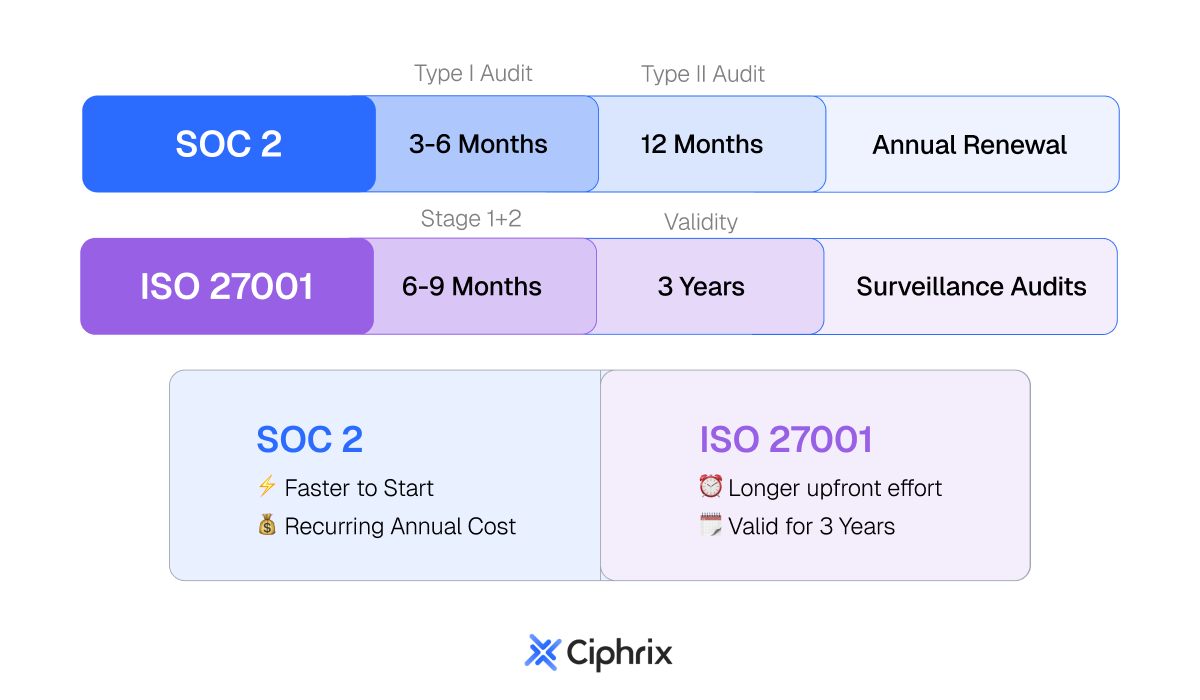
[IMAGE-TIMELINE: Dual timeline chart showing SOC 2 Type I → Type II path vs ISO 27001 Stage 1 → Stage 2 → Surveillance timeline]
SOC 2 Type I/II — prep windows & renewal
Type I is the fast on-ramp—many teams get there in 1–3 months once gaps are closed. Type II usually runs 3–12 months to gather evidence across the period, then audit. Keep a steady drumbeat on access reviews, logging, and tickets so renewals don't become fire drills.
ISO 27001 — Stage 1/2, surveillance, recertification
Focused teams often reach readiness in 3–6 months. You'll complete Stage 1 (documentation/readiness) and Stage 2 (implementation/effectiveness). You get certified, then pass surveillance audits each year, with a recert at year three. It's durable governance, not just paperwork.
Cost drivers & ways to avoid overruns
Drivers: scope breadth, control maturity, integrations, headcount, and (for SOC 2) extra criteria beyond Security.
How to save: right-size your scope, automate evidence capture (access reviews, vuln scans, log retention), and reuse shared artifacts across both frameworks. Small move, big payoff.
Which Should You Do First? (Decision Paths)
[IMAGE-FLOWCHART: Decision flowchart with 5 yes/no questions leading to 3 outcomes: SOC 2 first, ISO 27001 first, or phased approach]
US-first SaaS → SOC 2 first (Type I → Type II)
If ~80% of your pipeline is US, ship SOC 2 first. Land Type I fast for credibility, then slide into Type II for stronger proof. Build policies, a risk register, and monitoring with ISO-friendly structure so you can pivot smoothly later.
Global/regulated → ISO 27001 first
Selling across EU/APAC or into finance/health/gov? ISO 27001 is a better opener. Procurement teams know it, and partner programs often expect it. You'll still be in a great spot to add SOC 2 using the same evidence base.
Cross-border growth → Phased/parallel plan (6–12 months)
Need both soon? Do this:
Stand up ISMS foundations once (risk, policies, asset inventory, vendor risk, access reviews).
Pick the first external audit based on near-term revenue (SOC 2 Type I or ISO Stage 2).
Backfill the second standard with a mapped delta—not a second project.
Scenario Deep Dives (What this looks like in the wild)
A) US-heavy pipeline, mid-market SaaS (sales tooling).
Your top 20 prospects are US-based and already ask for SOC 2 in security forms. You run a 30-day hardening sprint (MFA, logging, access reviews, vendor risk), push a Type I audit, and publish a short Trust Center. You book Type II for a 6-month window. Deals unblock because buyers can see real dates and a fresh report is coming. Nine months later, you reuse the same evidence base to kick off ISO 27001 without re-inventing your program.
B) Global fintech integration partner program.
Partner docs call for ISO 27001 with an explicit scope statement. You stand up the ISMS once: risk register, SoA, policies/SOPs, inventories, vendor reviews, and monitoring. You pass Stage 2, then maintain surveillance. Six months in, one US prospect insists on SOC 2. No panic—you already have access reviews, tickets, logs, and change records. You map them to the Trust Services Criteria and complete a Type I quickly, then slot a Type II period that overlaps your ISO surveillance cadence.
C) Cross-border SaaS with looming enterprise pilots.
You'll need both inside a year. You start by standing up shared foundations (risk, policies, asset inventory, vendor risk, access controls, vulnerability management). You choose the first external audit based on the earliest high-value pilot (SOC 2 Type I or ISO Stage 2). While that's underway, you build the delta for the second standard in parallel. The outcome: two credible badges in under 12 months without running two separate programs.
D) Early-stage team <25, light security history.
You focus on the smallest cohesive scope (single product, single region, single tenant). You document what you actually do, not what you wish you did. You implement real logging/alerting (not just enabled features), prove MFA everywhere, and run your first access review. With the basics clean, either SOC 2 Type I or ISO Stage 2 is achievable—then you scale the scope as deals demand it.
A Practical 90-Day Action Plan (Pick SOC 2-first or ISO-first)
Days 1–15 — Foundation & scope
Lock scope (product, region, data flows).
Draft policies that match reality (access, change, incident, vendor, logging).
Build your asset inventory and data classification.
Stand up MFA, SSO, role-based access, and log retention targets.
Days 16–45 — Evidence engine
Start access reviews (privileged + sample users).
Turn on actionable alerting (failed logins, admin changes, anomalous activity).
Run vulnerability scans and create a simple patch SLA.
Centralize tickets/approvals for change and vendor onboarding.
Draft your risk register with owners and treatment plans.
Days 46–75 — Pre-audit hardening
Close quick wins from findings (MFA gaps, stale access, high vulns).
Finish SoA draft (ISO) or criteria mapping (SOC 2).
Dry-run an incident tabletop and record lessons learned.
Publish a basic Trust Center with non-sensitive info.
Days 76–90 — Audit window
SOC 2-first: perform a readiness review → Type I.
ISO-first: complete Stage 1, address deltas, then Stage 2.
Book your renewal cadence (Type II period or surveillance dates) so you never scramble again.
Pro tip: One owner, one source of truth for evidence, and weekly 30-minute checkpoints. That rhythm alone saves weeks.
Vendor risk management (questionnaires, contracts, SIG/CAIQ if used)
Security awareness training (completion records)
Mapping mindset & scope hygiene
Start with scope: products, tenants, regions, data flows. Keep a single control map that references Annex A and the TSC. Tag evidence to both. Keep your SoA and SOC 2 criteria matrix aligned so auditors can follow the thread. Less back-and-forth, fewer surprises.
[IMAGE-MINDMAP: Audit readiness mind map showing central "Audit Readiness" node with branches for shared evidence categories]
Common Pitfalls & How to Avoid Them
Over-scoping & policy bloat
Tighten the perimeter. Write short, actionable policies backed by real SOPs and logs. If your policy reads like a novella, it'll rot—and auditors can tell.
Weak evidence hygiene & log coverage gaps
Centralize evidence. Enforce MFA everywhere, ensure alerting is real (not just enabled), and keep retention long enough to cover your Type II period. Future-you will thank you.
Third-party/vendor risk blind spots
Track critical vendors, DPAs, sub-processor lists, and attestations. Run periodic reviews and chase remediation when signals turn red. It's cheaper than a surprise during due diligence.
FAQ
Is ISO 27001 harder than SOC 2? Different shape, similar effort. ISO 27001 is more program-heavy (governance, SoA, surveillance). SOC 2 is evidence-heavy over time (Type II). Your maturity decides which feels tougher.
How long does SOC 2 Type II vs ISO 27001 take? Many teams hit SOC 2 Type I in 1–3 months, then Type II after 3–12 months of operating evidence. ISO 27001 readiness often lands in 3–6 months, then Stage 1/2 and ongoing surveillance.
Do we need both for enterprise deals? If you sell globally or into mixed markets, probably yes—eventually. US-heavy pipelines usually start with SOC 2; global or regulated pipelines get more lift from ISO 27001 first.
Who audits each? SOC 2: licensed CPA firms. ISO 27001: accredited certification bodies (check IAF accreditation to avoid pushback).
How long are they valid? SOC 2: the report reflects a point or period; buyers expect annual refresh. ISO 27001: 3-year certification with annual surveillance.
Can we share our SOC 2 publicly? Most teams share SOC 2 under NDA because reports include sensitive system details. Your Trust Center can describe scope and the period covered, then handle access via request flow.
Does ISO 27001 replace SOC 2 (or vice-versa)? No. They signal different things to different buyers. ISO 27001 shows a certified management system; SOC 2 proves operating effectiveness over time. If your market spans US and global buyers, you'll likely want both.
Where do AI/ML and cloud specifics fit in 2026? Not a separate badge (yet). They live inside the same controls: access, monitoring, data protection, vendor risk, change management. Document model/data access, training data lineage, and third-party AI services like any other critical asset—auditors will ask.
What should you do next?
If a deal is already blocked by security → You need a fast path. Start preparation immediately and plan the first audit within this quarter.
If enterprise deals are coming in the next few months → Build the foundations first (policies, access reviews, logging) before choosing the certification.
If compliance is just exploratory right now → Don’t start an audit yet. Track buyer requirements and wait until deals depend on it.
Keep your demo CTA below this. Do not remove the CTA — this just routes readers before it.
Why this matters Readers now self-select into urgency level instead of ignoring the CTA completely.
Add this and tell me done.
If you're still figuring out whether compliance is blocking your deals, read: → Why enterprise deals stall at security review
Wrap-Up
Here's the simple play: match your first step to where deals are blocked. If you're US-centric, grab SOC 2 Type I to open doors and build toward Type II without drama. If you're chasing global or regulated buyers, ISO 27001 sets a sturdier foundation and carries farther in procurement. And if you'll need both, plan a phased route and reuse the same evidence so your second audit feels like a guided tour, not a second mountain.
Quick Re-cap
Choose the first standard by pipeline geography and buyer expectations.
Build ISMS foundations once; map controls to both standards from day one.
Keep scopes lean, automate evidence, and skip policy theatre.
Book a 15-min demo to see how we automate evidence collection and mapping.
Chaitanya is Head of Marketing at Ciphrix, an agentic compliance startup. He has led growth at several YC-backed companies and holds postgraduate degrees from Cambridge Judge Business School and Cardiff University. A keynote speaker at international conferences, he writes about compliance automation, agentic AI, and what it actually takes to scale B2B SaaS.


.svg) Back
Back.svg) AI Powered Automations
AI Powered Automations Policy Agent
.svg) Compliance Core
Compliance Core Compliance Engine
 Controls Management
 Automated Evidence
 Integrations (450+)
 Policy Management
 Audit Center
 Findings & Corrective Actions
 Third-Party Management
 Data Sub-processor Management
 Supply Chain Attack Surface Monitoring
 User Access Management
.svg) Risk Management
Risk Management Trainings
 Trust Center
.svg) SOC 2
SOC 2.svg) ISO 27001 (ISMS)
ISO 27001 (ISMS).svg) HIPAA
HIPAA.svg) GDPR
GDPR.svg) Australian Privacy Principle (APP)
Australian Privacy Principle (APP).svg) Any Custom Framework
Any Custom Framework.webp) 400+ Integrations
400+ Integrations.svg) Blog
Blog.svg) Help Center
Help Center.svg) Free Tools
Free Tools.svg) About Us
About Us Our Partners
.svg) Careers
Careers.svg) Contact Us
Contact Us.svg) Trust Center
Trust Center.svg)
.svg)
.svg)


.webp)
.svg)
.png)